Eternal Life: There’s More To It Than You Think

I once had an employee ask me what my most important teaching was. I didn’t know how to answer. I think they’re all important. Everything the Lord has shown me works together with other truths to make a whole. I said I couldn’t single out just one.

This man had been miraculously saved from a cocaine addiction, and he was listening to my teachings day and night. He wanted to get to the bottom of everything, or to the core of Christianity. So, he finally asked, “If you only had one opportunity to minister to a person, what would you teach?”

I still had to think for a moment, but quickly came up with an answer. I would share the meaning of true eternal life. That may not sound very profound or even foundational, but that’s because most people don’t know what the Bible means when it talks about eternal life.

Someone might say, “Eternal life is living forever.” But that’s not it. No one ceases to exist when they die. Everyone lives forever in either heaven or hell. “Well then, eternal life must be living forever in heaven instead of hell.” That’s not it either.

John 3:36 says,
“He that believeth on the Son hath everlasting life: and he that believeth not the Son shall not see life; but the wrath of God abideth on him.”

Everlasting life is a present-tense possession. It’s not something that begins when we get to heaven. There are a number of scriptures that speak of everlasting life as something we possess in this life (John 4:14; 5:24; 6:27; 6:40, 47).

So, the question remains, “What is everlasting life?” This is very important. John 3:16 says this is the reason that Jesus came.

“For God so loved the world, that he gave his only begotten Son, that whosoever believeth in him should not perish, but have everlasting life.”

Many people have mistakenly thought that the goal of salvation is the forgiveness of sin to avoid hell. That’s not what John 3:16 is saying. Sure, not perishing in hell is an important part of what Jesus came to do. He accomplished that by paying the debt for all our sins, past, present, and even the ones we haven’t committed yet.

If that’s all there is to salvation, that’s more than any of us deserve, and it would still be worth preaching. But salvation is much, much more than getting our sins forgiven so we can go to heaven instead of hell.

Let me say it this way. If all you did was ask Jesus to forgive your sins so you wouldn’t perish in hell, then you are missing out on eternal life.

Sin was a barrier that stood between us and a holy God. It had to be removed. That’s exactly what Jesus did, and He did it well. Sin is no longer standing between God and man (2 Cor. 5:17). But to what does that entitle us?

Sure, it entitles us to live forever with God in heaven. That’s wonderful. But there are tremendous benefits right here, right now, on earth. Eternal life is one of those benefits.

Jesus defined eternal life for us in John 17:3. That verse says,

“And this is life eternal, that they might know thee the only true God, and Jesus Christ, whom thou hast sent.”

Eternal life is knowing God. You may be disappointed with that definition. You think you know God and you still aren’t satisfied. You want there to be something more. The key lies in understanding what the Bible means by this word “know.”

This was speaking of much more than just intellectual knowledge. It can be seen in hundreds of Bible scriptures, like, “Adam knew Eve his wife; and she conceived, and bare Cain” (Gen. 4:1). Adam didn’t just know Eve intellectually. That won’t produce children. He had an intimate, personal experience with her. This was speaking of a knowing between a man and a woman in the most intimate way possible.

Likewise, when Jesus said eternal life was knowing God, He was speaking of having an intimate, close, personal relationship with God. That’s awesome!

Many people believe Jesus died to forgive their sins, but they still don’t have a close, personal, intimate relationship with their Father God. They think that is reserved for heaven. They are content to muddle through life singing songs about how, when we all get to heaven, what a day that will be.

That is not to take anything away from heaven, but we are supposed to have eternal life (close, intimate, personal relationship with God our Father and Jesus Christ His Son) right now. It’s not “pie in the sky by and by” but rather “steak on your plate while you wait.”

Jesus said in John 3:16 that God loved the world so much, He gave His only begotten Son so those who believed on Him wouldn’t perish but have everlasting life. If all you have done is believe on Jesus so you won’t go to hell, then you are missing out on the everlasting life the Lord wants to have with you right now.

Why is this so misunderstood? It is because the church has changed the message of salvation. They have placed a period after the word “perish” in John 3:16. They have told the world that the reason God sent His Son to die for their sins was so they wouldn’t perish, PERIOD. That excludes the true message of eternal life and intimate relationship with God as the goal of salvation.

Faith comes from hearing God’s Word (Rom. 10:17). If we don’t hear that Jesus came to bring us back into intimate relationship with God, then we won’t have faith for that and we won’t experience it. This describes the modern-day church to a tee.

We have many people who have come to the Lord and received the forgiveness of their sins, but they are saved and stuck. They are just waiting for heaven so they can really start living. That is missing the main point of salvation.

If there was no afterlife, if there was no heaven or hell, John 3:16 reveals that Jesus would still have come and died for our sins so we could once again have an intimate relationship with Him and His Father right now, in this present evil world (Gal. 1:4).

This was one of the main differences between the first-century church and our modern church. Those people knew God intimately. They had a relationship with the Lord that wasn’t waiting to start in heaven, but was working in them while they were still in this world.

They didn’t have the advantages of radio, television, internet, or any other modern means of communication. They never even put a bumper sticker on a camel. Yet, these believers turned the known world upside down with the truths of the Gospel in just thirty years (Acts 17:6). They impacted their world much more than we are impacting our world today. Why?

They had such a depth of relationship with a Living God that it was contagious. In Rome, Christians knew their God so intimately that they sang His praises as they were burned at the stake. There are historical accounts of Nero the emperor sticking his fingers in his ears and saying, “Why must these Christians sing?”

They had much more than a doctrine and a hope. They had a present-tense relationship that allowed them to endure with joy terrible atrocities. There are historical accounts of Romans, when witnessing the joy of these Christians who were being martyred, jumping out of the stands and rushing to them. They knew they would be doomed to the same fate, but they willingly accepted death so they could know God in the same close, intimate, and personal way as these Christians.

Let me ask you this question. It’s not intended to condemn you, but to enlighten you. How many people would die to have what you have? Is anyone envious of your relationship with the Lord? If not, then may I suggest to you that you aren’t experiencing eternal life as the Bible describes it and as our Lord Jesus died to give you.

This isn’t something for the select few. This is normal Christian living. In fact, if this isn’t your experience, you aren’t really living. This is what drove the Apostle Paul (Phil. 3:10) and all the early Christians. It’s still what drives victorious Christians today. It’s all about personal relationship with a Person, not just some doctrine. Andrew Wommak

Posted in Uncategorized | Leave a comment

The 7 costs of disciple-making: David Mathis (Desiring God)

Dietrich Bonhoeffer memorably wrote on the cost of discipleship, but he’d be the first to insist that the Christian life involves more than simply following Jesus by being his disciple. Better put, Christ’s call to discipleship (Luke 14:26–33) includes his call to disciple-making (Matthew 28:19).

And yet we live in a day in which everything else in life seems to be going in some direction other than life-on-life disciple-making. Let’s be honest, disciple-making isn’t rocket science. The vision is simple enough. Our need isn’t for more information but to do what we already know we should do, and in some ways want to do, but simply haven’t or aren’t yet. Most of us know enough; we’re just not doing it. Because we haven’t yet been willing to embrace the costs. We intuit the costs, but we haven’t embraced them.

Perhaps what might help us over our hurdles is not to hide how costly disciple-making is, but to be utterly honest and explicit about the costs, and hold them out in the light for us to see, and then find whether something in us might just rise to the peculiar glory of it all. God makes foolish the wisdom of the world, with its shortcuts and mass production, through the folly of disciple-making. As he did when his Son took a rag-tag band of uneducated peasants, invested in them at depth, and launched them out to change the world.

What Is Disciple-Making?

If the Great Commission is the first pillar of disciple-making, likely 2 Timothy 2:2 is the second.

What you have heard from me in the presence of many witnesses entrust to faithful men, who will be able to teach others also.

Disciple-making involves personal attention and guidance from one maturing Christian to another “younger” believer in the faith. It’s essentially spiritual parenting — intentionally and relationally investing oneself in the spiritual growth and maturity of a few disciples — part of which is training those disciples to then disciple others who disciple others.

What Makes It So Hard?

We could list dozens of costs, no doubt, but here let’s limit it to seven — and in particular seven that arise from the immediate context of 2 Timothy 2:2.

1. Opposition

For those of us who have heard 2 Timothy 2:2 so often, and may even repeat it from memory, how often have we kept reading and lingered over the next verse? “Share in suffering as a good soldier of Christ Jesus” (2 Timothy 2:3).

What is the very next thing the apostle Paul says after he gives his disciple Timothy the charge to make disciples who make disciples in verse 2? Verse 3: “Share in suffering.” Should we be surprised? The master disciple-maker himself was put to death on a cross. And Paul is writing this letter from prison to his disciple. Paul wasn’t locked up just for being a disciple of Jesus. If he would have just loved Jesus and kept it to himself, no one would have gone to all the trouble to put him away. No, he was in prison because he was fruitful to multiply his life by making disciples.

One of the costs of disciple-making we should weigh — and it may become increasingly more pressing in the years to come — is opposition, even persecution. Enemies of Jesus don’t usually bother Christians who love Jesus privately. It’s not worth the hassle. But when followers of Jesus are fruitful in making disciples, they become strategic targets for resistance. Very few today oppose simply holding the Christian faith; it’s proselytizing — or disciple-making — that will get you into trouble.

2. Attention

“No soldier gets entangled in civilian pursuits, since his aim is to please the one who enlisted him” (2 Timothy 2:4). We live in the age of distraction. And not only will disciple-making be sidelined if we smartphone and entertain ourselves to death, but Satan has a thousand ready-made, event-oriented distractions to divert us from pleasing Jesus in the grunt work of gospel advance called disciple-making. We are bombarded not just by obvious time-wasters, but good initiatives that, if we’re not careful, will not supplement disciple-making, but supplant it.

The cost of not getting “entangled in civilian pursuits” includes staying on mission, but not only that. Attention is required in our scheduling, and attention is required in the moment, at the dinner table, or over coffee, or in whatever context in which we give our undivided attention to the one(s) in whom we’re investing.

3. Pleasing Others

This is a great cost for some of us (and too little for others). Our aim is “to please the one who enlisted” us (2 Timothy 2:4), not anyone who walks through the door, or joins the church, or deems themselves worthy of our regular investment. One of the hardest aspects of the disciple-making process is “selection.” Jesus chose twelve, and in doing so left out hundreds, even thousands, who would have benefited from his time and energy.

In disciple-making, we need to remember our aim is to please Jesus, and this will cost us favor with certain persons, especially when we have to say no to our involvement in their program or event or even to discipling them personally, because we’re protecting the space to invest in others.

4. Perseverance

Paul continues, “An athlete is not crowned unless he competes according to the rules” (2 Timothy 2:5). Disciple-making often feels like a long lap around a big stadium. It would be so much easier to take a shortcut across the field. We’re tempted to cut corners by constructing programs and systems that will mass-produce disciples without the very personal costs involved. But disciples who make disciples can’t be mass-produced. I’ve seen it again and again when Christians made by event after event, but not coupled with intentional, relational, gospel-centered disciplemaking, go haywire at the strangest times.

Defaulting to the easier, often more single-event, hype-oriented methods simply does not produce the same depth of gospel transformation — and then gospel transmission and multiplication — as life-on-life disciple-making.

5. Energy

Another cost the athlete image in verse 5 calls to mind is the energy it involves to disciple. This is one of the greatest, and most underrated, costs. Early-morning and late-night intense conversations drain our emotional tank. It’s much easier to avoid them and just watch television. Disciple-making costs us energy. But when you have a one-on-one meeting scheduled after a long day, or an early morning appointment after a short night, the discipler says with Paul, “I will most gladly spend and be spent for your souls” (2 Corinthians 12:15).

When we think we can’t do any more, we keep pushing to the finish line, like an athlete, as we learn the invaluable dynamic of serving in another’s strength (1 Peter 4:11) by leaning on God, and walking in faith, for energy we don’t think we have.

6. Taking the Initiative

“It is the hard-working farmer who ought to have the first share of the crops” (2 Timothy 2:6). Perhaps simply stepping out and taking the initiative is where more of us get caught up than anywhere else. We have a vision. We see a select few who seem to be strategic for our investment for a season, but we’re paralyzed by simply taking the initiative to have the potentially awkward conversation about getting together regularly to read the Bible and pray.

Initiative is so huge today. So much of leadership is simply initiative. You don’t need to have all the answers; you don’t need to have everything figured out. People often simply need someone to risk the awkwardness, and risk being misunderstood, and take the initiative to get the process going. And with it, of course, comes the need for some basic planning: how often will we meet, where will we meet, what if anything will we study together, how long will the commitment be, in what areas does this person need to learn and grow?

7. Time

Of all the costs, time may be the greatest. Disicple-making, like a farmer raising crops, is time-consuming. Big time. It takes time to plow the field, time to plant, time to water, time to fertilize, then time to harvest. So it will be with disciple-making. It’s not one meeting, but often a year’s worth of regular meetings. It’s not one conversation, but sometimes difficult conversation after conversation. Which requires patience.

As with farming, we don’t see the progress all at once. And yet, over the course of months, it’s amazing what kind of harvest can happen.

More Blessed to Give

In the end, disciple-making is costly because it demands continuously giving — giving time, giving energy, giving attention, taking initiative, making sacrifices, facing opposition, losing privacy, embracing obscurity, even shedding tears. Disciple-making means not just sharing the gospel, but sharing our own selves (1 Thessalonians 2:8), gladly spending and being spent for the souls of others (2 Corinthians 12:15). It means giving, giving, giving.

And the great discipler said, “It is more blessed to give than to receive” (Acts 20:35). The heart of his disciples, in our labors to disciple others, learns to say, “It makes me happier for you to have my time, my energy, my attention, my initiative than for me to keep them to myself.”

Posted in Uncategorized | 1 Comment

from Ray Pritchard

“I hasten and do not delay to keep your commandments” (Psalm 119:60).

Delay is deadly to the spiritual life. We can always find reasons to procrastinate if we don’t want to obey God. How blessed are those who are eager to do God’s will.

Delayed obedience is disguised disobedience.

May God make us quick to . . .

Hear his Word,
Seek his face,
Repent of our sin,
Forgive others,
Speak for Christ,
Serve others in Jesus’ name.

Posted in Uncategorized | Leave a comment

From Desiring God

A Simple Way to Pray Every Day

Nick Aufenkamp / February 5, 2017
A Simple Way to Pray Every DayOf all the things Martin Luther is known for, among the foremost is his dedication to prayer. He is famous for commenting, “I have so much to do that I shall spend the first three hours in prayer.” He wasn’t exaggerating, either. Many of his friends and students could attest that he would spend several hours on his knees in fervent, daily prayer — often at seemingly inopportune times in the middle of the day.


At one point, Luther’s barber and longtime friend, Peter Beskendorf, asked if he would teach him how to pray. Luther responded by writing Beskendorf a letter which he called, “A Simple Way to Pray.” Luther’s letter is a gourmet buffet for all Christians who hunger for more rich and satisfying prayerfulness.

While I would encourage anyone to enjoy the full buffet, for now I will simply provide the first course: a simple way to pray by using the Lord’s Prayer.

Prone to Wander in Every Age

But why should we go to Luther for help praying in the twenty-first century in the first place? Most of our modern problems with prayer are born of distraction: email alerts, Facebook notifications, constantly revolving media. How can Luther help us with these sorts of problems?

In fact, Luther directly approaches this very obstacle in his letter. Hear how his words resonate with your own difficulties with prayer:

Guard yourself carefully against those false, deluding ideas which tell you, “Wait a little while. I will pray in an hour; first I must attend to this or that.” Such thoughts get you away from prayer into other affairs which so hold your attention and involve you that nothing comes of prayer for that day. . . .

We must be careful not to break the habit of true prayer and imagine other works to be necessary which, after all, are nothing of the kind.

It is strangely encouraging to be reminded that our temptation toward distraction from prayer for the sake of seemingly “more productive” tasks is not unique to the digital age. The problem of our prayerlessness is not simply with our smartphones or schedules. The problem is with our hearts. So, if we really want to grow in our prayer life, we must take aim at something much deeper than surface distractions: our most inward affections and desires.

And this is where the Lord’s Prayer is most helpful.

How to Pray as Jesus Taught Us

First, Luther recommends simply to pray through the prayer once, as recorded in the Gospel of Matthew (Matthew 6:9–13). He then says to go back through the prayer and pray each petition individually:

  • Our Father in heaven, hallowed be your name.
  • Your kingdom come, your will be done, on earth as it is in heaven.
  • Give us this day our daily bread,
  • And forgive us our debts,
  • As we also have forgiven our debtors.
  • And lead us not into temptation, but deliver us from evil.
  • For yours is the kingdom and the power and the glory forever.
  • Amen.

Luther exhorts us to let each petition guide our prayer. So, after praying, “Our Father in heaven, hallowed be your name,” we may continue to pray, “Yes, Father, it is our great desire that your name would be feared and revered for who you are: our God, our Creator, the Holy One who, in unthinkable mercy, gave your only begotten Son to save us from your wrath upon our sin.”

We can then move to the next petition, “Your kingdom come, your will be done, on earth as it is in heaven,” and pray, “We know that Jesus is reigning right now with authority over all things, and yet we still experience much brokenness here on earth. Father, bring your kingdom in greater measure today beginning in my own heart and pouring out to my home, community, city, nation, and to the ends of the earth.

Eventually, we move through each petition until we’ve reached the “Amen.” We might be inclined to think of the Amen as the simplest, least significant part of the Lord’s Prayer. However, Luther does not dismiss it so quickly. Instead, he exhorts us to make a bold, powerful, and confident “Amen.”

You must always speak the Amen firmly. Never doubt that God in his mercy will surely hear you and say “yes” to your prayers. . . . Do not leave your prayer without thinking, “Very well, God has heard my prayer; this I know as a certainty and a truth.” That is what Amen means.

Three Benefits of Praying the Lord’s Prayer

There are probably dozens of benefits to praying to God as God himself taught us. Here, I will just offer three. Praying the Lord’s Prayer enables us to:

1. Seek first his kingdom and his righteousness (Matthew 6:33).

Personally, I tend toward praying inward-focused prayers that center on my confession, my problems, and my requests. Praying the Lord’s Prayer as Luther recommends helps us to seek a greater awareness of Christ, other people, and God’s broader mission in our prayers.

2. Discipline our wandering minds.

Our minds drift so easily in times of prayer. One moment I’m praying, the next I’m thinking about that email I need to reply to. Utilizing the structure of the Lord’s Prayer helps me to recognize when my mind has wandered and helps me remember where to pick up again.

3. Build a fence so our prayers can run wild inside.

As I mentioned earlier, our lack of prayerfulness is chiefly a heart issue. Some people may push back on this method of prayer, saying that it is too structured and therefore restrains the Spirit’s spontaneous leading. In fact, I have found the opposite to be true.

As someone who has always favored unscripted prayers that express heartfelt longings and desires, I have not found structure and spontaneity to be at all at odds with one another. I am amazed to find that, every time I pray through the Lord’s Prayer as Luther has commended, my prayers have been richer, deeper, and more revealing, and have unlocked affections that are otherwise seldom seen.

Learning to Desire God as God Desires

Why would Jesus command us to “pray like this” (Matthew 6:9)? Jesus did not simply provide some words for disciples who had nothing else to say to God. Rather, the Lord’s Prayer is meant to have a total, shaping effect on our hearts, helping us to see and yearn for the very things that God himself desires — most centrally, to see and experience more of God himself in our hearts and lives.

Obviously, there’s no silver bullet for achieving the perfect prayer life, but I have found Luther’s method to be an effective weapon in fighting for a richer prayer life. Personally, I’ve experienced a renewed sense of expectancy in prayer, with more excitement and intentionality, and a deeper love for Jesus and appreciation for the cross-won gift of prayer. Inasmuch as it has benefited me, I commend it to you.

With that, I will end where Luther begins: “I will tell you as best I can what I do personally when I pray. May our dear Lord grant to you and to everybody to do it better than I! Amen.”

Posted in Uncategorized | Leave a comment

Wait a minute…

Daily Dig for January 31

Henri J. M. Nouwen

Waiting is not a very popular attitude. Waiting is not something that people think about with great sympathy. In fact, most people consider waiting a waste of time. Perhaps this is because the culture in which we live is basically saying, “Get going! Do something! Show you are able to make a difference! Don’t just sit there and wait!” For many people, waiting is an awful desert between where they are and where they want to go. And people do not like such a place. They want to get out of it by doing something.

Posted in Uncategorized | Leave a comment

A challenging word….

Thirty Seconds Alone with God

The Effect of Our Phones on Prayer

Article by

Senior writer, desiringGod.org

Our Twitter and Facebook habits make praying harder than ever.

But before we look at the stats, let’s take a moment to appreciate the magic of conscious life, the capacity to focus on one thing, like this article and this unfolding sentence, following it along until it ends with a little dot. No doubt, as a reader, you’re fighting the chronic digital urge to skim.

We give our attention because we have attention to give. With our attention we can attend to one thing and avert from another thing.

The power to fixate is part of God’s miracle in creation. Without attention, faith would be impossible. God not only created us to live and breathe and walk, like his other creatures; he wants us also to believe in him and to trust his word, to listen. The full scope of our affectional life becomes precious when we see it as our capacity to attend.

Mind-setting is the basis of our devotion to Christ, and it gives rise to every love and longing in our heart. What our eyes linger on, our hearts will learn to love. What our hearts love, our eyes will linger on. When by supernatural grace Christ becomes the highest prize in our life, then he becomes the supreme focus of our attention. Thus, Paul challenges us to “set your minds on things that are above, not on things that are on earth” (Colossians 3:2).

But in the digital age, our attention faces multiple tensions. Each day we give our eyes to movies and new music and books and online articles and viral GIFs and hot Facebook trends. We have only so many waking hours, only so many caffeinated hours, only so many ways to listen, watch, and read even a small fraction of the content that endlessly pours in from our feeds and our friends.

The span of our attention is of great concern to God. Long before the media age brought with it profound changes in how we reproduced and multiplied pages in the printing press, and long before breaking news (and fake news) buzzed and beeped on our smartphones, God was always concerned with our focus.

Gospel Attention

Gospel faithfulness is about attention. In eighty places in the Bible, God’s people are called to take heed, which is the urgent language of attention.

Specifically:

In all these areas, and others, God calls us to guard our attention.

Welcome to the Attention Economy

Within the urgency of Christ’s return, historically, the church has enjoyed a corner on the attention market. But that dominance is now long over, as law professor and technology expert Tim Wu explains in his new book, The Attention Merchants: The Epic Scramble to Get Inside Our Heads (2016).

To be sure, it isn’t as if before the twentieth century everyone was walking around thinking of God all the time. Nevertheless, the Church was the one institution whose mission depended on galvanizing attention; and through its daily and weekly offices, as well as its sometimes central role in education, that is exactly what it managed to do. At the dawn of the attention industries, then, religion was still, in a very real sense, the incumbent operation, the only large-scale human endeavor designed to capture attention and use it. But over the twentieth century, organized religion, which had weathered the doubts raised by the Enlightenment, would prove vulnerable to other claims on and uses for attention.

Despite the promise of eternal life, faith in the West declined and has continued to do so, never faster than in the twenty-first century. Offering new consolations and strange gods of their own, the commercial rivals for human attention must surely figure into this decline.

Attention, after all, is ultimately a zero-sum game. (27)

Grabbing attention is where corporate profits are made, which is why advertising is so potent. Products need time to flicker in pixels before our eyes. This monetizing of the gaze has given rise to what is now called the “attention economy,” run by “attention merchants.” The end-game is profit by grabbing our attention. Thus, the competition for our gaze — and the competition for our wallets — is stiff.

May I Have Your Attention, Please?

Wu makes an important point, if slightly overstated.

First, Jesus was clear in warning the first century to guard themselves from the consuming desire for wealth. Love of money is a corrosive idolatry and an attentional misfire away from the heart of the gospel (Matthew 13:22). Our eternal attention has always been flitting to worldly things. So the church has never enjoyed exclusivity in the market of human attention. But Wu’s observation is important to see, especially as he traces the “attention merchant” tycoons who monetized the printing press, radio, television, and eventually the smartphone. They compete with the gospel for the human gaze.

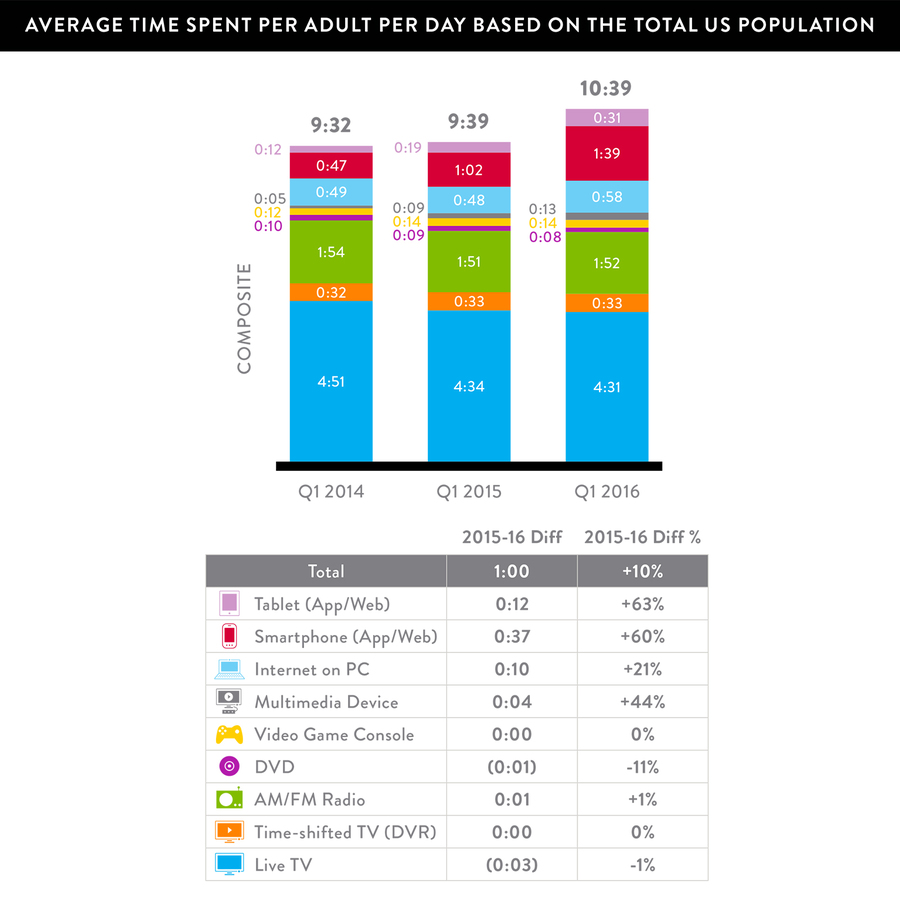
But since human attention — for all its glorious purposes — is a finite resource, theoretically, our attention is a zero-sum game. Nevertheless, we still try to fill our lives with more and more media. According to a 2016 Nielsen report on media use, American adults now use media for a combined 10 hours and 39 minutes every day, a sharp rise of one hour from just one year earlier (9 hours, 39 minutes).

Notice carefully what changed and what stayed the same here.

Most obviously, this 2016 spike in media use factors to the ubiquity of mobile devices, like tablets and smartphones. In other words, smartphone use grabs more attention without taking away much of any time we already invest in television, music, gaming, and desktop computing.

Though some predictions suggest social media will start to pull viewers and advertising revenue away from television in 2017, the Nielsen stats confirm the growing suspicion that our mobile devices, our tablets, and especially our smartphones are filling in more and more of life’s little gaps with perfectly sized bits of consumable media.

In this, the ten-year anniversary of the iPhone, the attention merchant’s dream device, every one of my waking moments are now targeted.

“Mobile is a great market. It is the greatest market the tech industry, or any industry for that matter, has ever seen,” technology analyst Ben Thompson wrote back in 2015. Why? “It is only when we’re doing something specific that we aren’t using our phones, and the empty spaces of our lives are far greater than anyone imagined. Into this void — this massive market, both in terms of numbers and available time — came the perfect product.”

Smartphones make it possible for the attention economy to tap our little 30-second attention gaps as we transition between tasks and duties. In the past, these moments proved more difficult to target.

Our attention is slightly elastic, elastic enough to fill up every empty gap of silence in our days, but in the end it’s still a zero-sum game. We have limited amounts of time to focus in a given day, and now every second of our attention can be targeted and commoditized.

Never Stop Praying

Back to prayer. Prayer requires our divine-centered attention. For a moment (or longer) we consciously pray to the Father, in the name and blood of the Son, through the Holy Spirit — not just in our morning entreaties, or mealtime thanksgivings, but little petitions sprinkling life into our days.

Paul calls us to the discipline of prayer. We must not only pray without ceasing (1 Thessalonians 5:17), we must pray without ceasing in a spirit of undaunted alertness (Ephesians 6:18) — that is, with our full attention.

Perhaps the best example of what it means to live a productive life while also praying without ceasing comes from the life of nineteenth century preacher Charles Spurgeon who shared his secret to a close friend: “I always feel it well just to put a few words of prayer between everything I do.”

To pray without ceasing is not a neglect of daily duties. It is not multitasking with our attention split half on God and half on work. It’s about claiming the momentary transitions in our day, the rare empty moments of silence, to focus our attention on God himself.

Reclaiming Our Prayers

So, if the human gaze is both spiritually valuable and commercially marketable, where does my attention go? What has my attention? Or, better, who has my attention, especially in the gaps and transitions of my day?

A candid Charles Spurgeon could tell his friend, “I always feel it well just to put a few words of prayer between everything I do.” When I’m being honest, I say: “I always feel it well just to publish a tweet or two between everything I do.”

In the little cracks of time in my day, with my limited attention, I am more apt to speak into social media than I am to pray. That’s the brute honesty of the situation. And because of this negligence, God feels more distant to my life as a result.

Leave it to a leading prayer expert to connect social media habits, prayer neglect, and a felt distance with God’s presence.


.@RyanWortman Noise and distraction. It is easier to Tweet than pray!

— Timothy Keller (@timkellernyc) December 31, 2013

(A point made on Twitter, no less).

As Peter tells us, “The end of all things is at hand; therefore be self-controlled and sober-minded for the sake of your prayers” (1 Peter 4:7). All of this shapes what we should be doing with the margins and gaps in our daily attention.

Yes, there are apps and alerts to remind us to pray. And may we use them. But in the digital age, every fragment of our attention can now be claimed and monetized by the attention merchants. Our attention is finite. But our call to constant prayer is clear. It’s time to be honest: The worst of our compulsive social media habits in the empty spaces of our lives is corroding our prayer lives.

Posted in Uncategorized | Leave a comment

The emotional journey of creating anything great!

http://image-store.slidesharecdn.com/183f7a49-d2b7-4dee-8866-a23f131315a9-large.jpeg

Posted in Uncategorized | Leave a comment

A Seasonal Word

This is a seasonal, seasoned, seasoning, salty word from the President of Healthcare Christian Fellowship International:

I am deeply troubled by the pretentious prophecies of so many new year messages. All of them catering to that unholy trinity of the flesh: I, me and myself. These false ticklers of the ear proclaim stuff like: I speak prosperity and health and success etc.

In the health field we cannot hide in these cozy cocoons of “Christian” life. We face suffering and death daily. We are confronted with the victims of the more than forty wars currently being fought globally. We agonize over the more than eight million children who die from preventable diseases each year. The roughly fifty million migrants from all over to all over have serious and urgent healthcare needs. Many more millions in our neighborhoods and communities have not seen the Good News demonstrated in our relationships with them nor have they heard it explained in terms they can understand.

It is time to disembark from the prosperity train, brothers and sisters. Do not let them deceive you with their seductive sweetly-spoken spiderweb. Their poison will numb you to the things that break the heart of our Lord and Saviour. His command that we are to go into all the world and to make disciples of all the nations is distorted into ‘come to our Sunday Show and our Prophet will Greatly Impress you’.

How does our Lord know that you love Him in attitude, words and deeds? Are your neighbors convinced that you love them? Do your disciples think you are really helping them to multiply?

May our 2017 life-style also be a Life-style as our Lord empowers and enables us to love Him and our neighbors in ways that bring joy in Heaven as His kingdom comes in and through us.

Shalom,
Chris Steyn
President

Posted in Uncategorized | Leave a comment

Resolutions

Resolutions Are Not Enough

David Mathis / December 30, 2016
Resolutions Are Not EnoughNew Year’s resolutions can be an important first step, but they are a far cry from real, lasting change.

The ringing in of a new year brings with it the possibility of a fresh start, or at least a fresh reminder to turn the page on some (or many) ways we’d like to grow and mature in the next season of life. But haven’t we all tried this enough times by now to know how futile mere resolves are if not accompanied by more?

Whether it’s eating and exercise, or Bible-reading and prayer, the God-created mechanism we call “habit” is vital for seeing our earnest resolutions through to enjoyable realities. If we really are resolved to see our hopes for 2017 become life-enriching habits, we will do well to keep several basic truths in mind at the outset of a new year.

1. Focus on a Few, Not Many.

Better than big emotional, private resolves about the many things you want to “fix” about your life is dialing in just one or two realistic, and really important, resolves with a concrete plan and specific accountability. The excitement of a new year, and ease with which we can desire change, often leads us to bite off way more than we can chew for a new year.

It’s much better to focus on just a couple new habits — even better, just one. And if you’re going to narrow it to just one (or maybe a couple or three), you might as well make it count. Identify something important that will give your new-habit-forming particular focus, even while this one resolve will reap benefits in other areas of your life. Soul-strengthening “habits of grace” are precisely this. Going deeper in God’s word, prayer, or your local church will produce an invaluable harvest.

Consider a specific focus for the new year, or just the first three months of 2017, or even just January. A year is a long period of time in terms of habit-forming; typically we would do much better to just make one resolve at a time, and do so every few months, than to attempt many things and for so long a period as twelve months.

2. Make It Specific.

Bible intake, prayer, and Christian community likely are too broad in and of themselves. Give it more specific focus like reading the whole Bible this year, or not just reading but daily meditating on a short passage or verse, or even just a word or phrase (in context). Don’t keep it general at “prayer,” but make it more particular: private prayer each morning, or bedtime prayer with your spouse or family, or punctuating your day with “constant prayer,” or some new prayer initiative as a community group or church.

Perhaps as the old year is coming to a close, you’re realizing how spotty your church commitment has been, and how thin your relationships are as a result. You might resolve to deepen your commitment to not neglect your meeting together “as is the habit of some” (Hebrews 10:25), whether that’s making Sunday mornings more nonnegotiable or prioritizing your midweek investment in life together in community group. Resolve in 2017 not to let silly last-minute excuses keep you from faithfully gathering with the body of Christ, which will be a priceless, long-term means of God’s grace both to you and through you, to others.

3. Craft a Realistic Plan.

However earnest your resolution, you need a corresponding amount of realistic planning. Let’s be honest, you don’t really want to enrich your prayer life if you’re not willing to give it even just a few minutes of creative thought about where, when, and how you will pray in 2017. Map out clearly and concretely what it would take for a full month to cultivate the habit. Think long term and make sure it’s realistic.

Part of being realistic is accepting a measure of modesty to your goals. Don’t try going from no regular devotions to an hour every morning. Start with a focused fifteen minutes a day, perhaps even ten, but make it genuinely nonnegotiable, and see what God does. Grow your duration and depth as Scripture intake becomes a fixture in your schedule, and you learn to wake up each day even more hungry for the Bible than for breakfast.

4. Identify the Reward.

Runners will tell you that being heart-healthy in their old age is not their driving motivation. It’s a nice added benefit, of course, but a reward that is nondescript, and a long way off, won’t get you out of bed in the morning and into your running shoes on for long. Rather, what motivates most long-term runners is feeling great today, whether it’s the endorphins, or the sense of accomplishment or clear-headedness, or all the above.

Trying to draw on the same long-range motivation each morning to get out of bed and hear God’s voice in the Scriptures will soon run dry. And God doesn’t mean for us to be motivated merely by distant, future rewards, important as they are. God supplies bountiful motivations for today. His mercies are new every morning (Lamentations 3:22–23). He means for us to taste and see his goodness right now (Psalm 34:8). He can meaningfully satisfy our restless souls in real, life-transforming measure right now.

Over the years, I have found the most transformative reward in cultivating habits of grace to be, not being stronger and holier as a Christian long-term, but knowing and enjoying Jesus today. Having my soul satisfied in him today. Making my heart merry in him this morning.

The point of daily spiritual discipline isn’t first and foremost being holy or obtaining growth, but knowing and enjoying Jesus and having our souls satisfied, imperfectly but powerfully, in him. The final joy in any truly Christian habit or practice or rhythm of life is, in the words of the apostle, “the surpassing worth of knowing Christ Jesus my Lord” (Philippians 3:8). “This is eternal life” — and this is the goal of the means of grace — “that they know you, the only true God, and Jesus Christ whom you have sent” (John 17:3). Fly Hosea 6:3 as a banner over your 2017 spiritual resolutions: “Let us know; let us press on to know the Lord.”

5. Enlist Regular Accountability.

One of the flaws in so many resolutions is that they stay private. When we really mean it, we draw in real and regular accountability. We are sinners. Our heads are not always screwed on straight. We need others to speak into our lives, and hold us accountable for who we’ve said we want to be, and what we’ve said we want to do.

Perhaps talk through some of these principles for forming good habits and consider a monthly calendar reminder to check in with each other. It is a great means of God’s grace that he has not left us alone in forming spiritual habits.

6. Cover Your Efforts in Prayer.

At the end of the day, and the end of another, the Holy Spirit is decisive, not our spiritual habits, for producing any lasting, spiritual fruit. Cultivating wise habits are not our attempt to work for God’s acceptance, but to work out our salvation (Philippians 2:12–13).

In prayer, we re-consecrate ourselves again and again to pursue our resolves “by the strength that God supplies — in order that in everything God may be glorified through Jesus Christ” (1 Peter 4:11). We would be foolish to pour fresh, regular efforts into new spiritual habits without explicitly asking God to make it truly fruitful.

And so we pray — not just act, but ask — “that our God may make you worthy of his calling and may fulfill every resolve for good and every work of faith by his power” (2 Thessalonians 1:11).

Resolutions are not enough. But God has not just left us to resolutions.

Posted in Uncategorized | Leave a comment

Happy New Year!

I AM THE NEW YEAR
By Pastor Barry Black

Deuteronomy 11.12
“…the eyes of the Lord thy God are always upon it, from the beginning of the year even unto the end of the year.”

I will help you to say goodbye to the previous year filled with “yesterdays” and comprised of
Disappointments and surprises
Losses and gains
Failures and Successes
Defeats and victories
A year which may be remembered by recalling…
Fleeting moments
Delightful memories and good times
The sobering reality of missed opportunity
The insight gained from daily living
The unexpected surprise of reconnecting with old friends.
The joy of sins forgiven
Golden words fitly spoken (Proverbs 25:11)
And the fruit of obedience and pleasing the Lord
Yes, the old year is a time in which we can recall with gratitude…
Blessings, protection, and rewards from the Providential hand of God
Grace that was sufficient for our every need
Mercy received when justice would have just as easily been fitting for us.
And realizing that even bad things that happened could have been worse…much worse.
May your past productively transition to the future as you experience…
The warm daylight of lessons hard learned,
and the fading sunset of the pain that was long endured while living through them.
The priceless value found in genuine friends,
and the sober understanding of the shackles of superficial people who merely use us.
The glorious journey of…
The unmatched wealth in reading and studying the Bible
The unparalleled stability of Christian fellowship
And the unrivaled enjoyment of serving the Lord.
And as you experience the wise departure from…
The comfortable enticement of procrastination
The deceptive decoy of excuses
The childish pleasure of pettiness
And the dull applause of mediocrity.

I AM THE NEW YEAR.
I am…
The challenge of new goals
The desire for spiritual growth
The continual burden for lost souls
The anticipation of answered prayer
And the eager expectation of Christ’s soon return for His Bride, the Church.
I am the New Year, I may only be lived one moment at at time.
I am replete with the unknown
and rife with…
Opportunities to trust
Unexpected moments of blessing and delight
Satisfaction for spiritual truth and hunger
Motivations to give of your time and effort to people and projects
And the joy and privilege of serving the Lord in new and exciting ways.

YES, I AM THE NEW YEAR!

Posted in Uncategorized | Leave a comment